Thursday, August 8, 2013

Saving While Away

Travel is expensive not just because of the expenses associated directly with the travel itself: transportation, food, accommodation -- living away, basically. It is also expensive because I still have to pay what I used to pay when I was not traveling for stuff that I won't be using while away.
 
I still have to pay my monthly rent even though I am not using my place, still have to pay my gym membership because I had agreed to do so for at least a year, still have to pay for my office space because that's what the agreement says, and I still have to pay for my phone for little to no use (for fear of not being charged long distance, I hardly make any calls while away).  

Trying to maintain your regular lifestyle is what makes my travels even more expensive. Gym, for example. These days visiting a fitness centre at least twice a week is a habit as essential as getting a cup of coffee every day. So that's the first thing I wanted to do on my second day of my stay in Edmonton. I look up the gym that I have a membership for, and it turns out that they have two locations: both within 10 minutes drive of each other, but so far away from where I stayed that it would take me 3-4 buses plus a train ride and more than an hour to get there. Not workable. I only have access to a car for a few days and I like my gyms walking distance to my place.

After going to my gym for a day, I quickly started to look for closer alternatives. I was very attentive to my surroundings as I walked around town in the next few days (I had done hours and hours of walks during my stay).  There was a YMCA in downtown, within walking distance from my place. But I know YMCA is pricy for short-term purposes. I ran into a massive city-run fitness facility during one of my long walks. I walk-in and ask for rates. That's not any better than YMCA. Lots more fitness, location and activity options than any gym I had seen before, but too expensive for my purposes. It was a bit of a walking distance for me to visit regularly.

I left the facility reconsidering my fitness options: either make fewer, 2+ hours trips to my regular gym, or find some other non-gym exercise alternatives. I had almost settled on my plan when I passed a university fitness centre. I decide to walk in and check what their rates were. They had summer specials! I could pay $20 for two remaining weeks of the month. That's almost the same as their daily rate. So I had a gym within a few minutes of my place for a reasonable pay.

When my two weeks were over, I found myself wanting to go to the gym again. I only have a week of stay to go, and it didn't make sense to do daily visits to my now former gym -- too expensive -- so I considered to make my 2 hour minimum trip to my regular gym.  I decided to do some more searches for closer facilities to see if I can avoid the travel. I search Google Maps for fitness centres in my neighborhood and call one that I found not very far...their rates are $9 per day, but why don't I visit and see if I can get a complementary free day pass? Visit I do, and I was presented with a 3-day free pass. Exactly what I needed. This being a neighborhood small, somewhat aged fitness centre, the facilities weren't as great as my pricy regular centre nor the university one, but it was good for my purposes.

And cheap enough that I felt like I saved some money during my otherwise expensive travel time.


Thursday, July 7, 2011

Thinking in the Language You're Writing

Perhaps the most useful information I've extracted from U of T's career manual titled "keys to your future: a powerful resume and cover letter" (2006):

Each language has its own internal logic and structure. What is correct in one may not be necessarily correct in another. Avoid unnecessary errors by thinking in the same language in which you are writing.

I have had errors that are direct results of failing to follow the above advise (in addition to my struggle with my ongoing struggle with prepositions). I am fairly accustomed to thinking in English by now. In fact, I've been doing that since my early days of my Canadian life. But I still find myself falling into the trap of making English statements that can only be understood if one also understood Tigrigna. This may even be apparent in some of my writings on this blog.

I noticed during my stay in Quebec that, even though many of the tourist information materials there were printed in French and English, the English part was not readily understandable. Here is a classic example from a French-langauge offering university in Quebec:

Our summer intensive 3 and 5 - week programs begin in July. Those programs are offered to 18-year old, and older, and are opened to university students, teachers, business people, retired people or anyone wishing to improve his-her proficiency in French. Since all levels are offered from real beginners to very advanced, you will find a class corresponding to your proficiency in French.

For a more complete learning of French, in addition to the 20 hours spent in classroom every week, you will participate in a wide variety of socio-cultural activities. There are also tourist activities on weekends which will be offered on an optional basis.

Besides classes and extracurricular activities, you will live in French with a francophone host family (or on campus at the university residence) where you will experiment some aspects about the culture of Quebec. This will make your immersion a total immersion.


I think how you communicate in one language is a lot more than in what language you "think." A friend, who was at that time new to Canada, once told me that his native English speaking classmates remarked that he "speaks as if he is reading a book." We agreed then that it was because he speaks as if reading a book because he learned English through reading books. He comes from a school system that emphasizes a lot on the grammar and structure of English, but does little to encourage spoking in English. Missing from his (and my) vocabulary were the words and phrases that are the most often used in everyday Canadian English (I remember realizing how important it was to practice common words and phrases in my Early Canadian days, when I had emails to my cousins with as many of the new words as possible -- one email had most of its sentences ending with "and stuff", another was littered with "you guys".)

Wednesday, July 6, 2011

Paper Dollars

It was a rip-off.

That's how it felt when I paid what I always have paid for my grande (yes, I upgraded from tall) Starbucks coffee. I paid in U.S. dollars. The adjusted price was the two dollar bills plus 24 Canadian cents. It is not that I paid more for it that makes a rip-off (the regular Canadian dollar price is $2.10), but the fact that I paid in PAPER bills. The money felt to have had more value than, say, when I would have to pay using a two dollar Canadian coin plus a dime. Two (or even ten, depending how much change I happen to carry) COINS versus two dollar BILLS makes a huge difference on how I perceived my expense.

Well, that's what I heard is partly why there doesn't exist Canadian dollar bills; just coins.

Monday, May 9, 2011

Citizenship

I don't remember attending a major political event, except at very local levels like campus student bodies, or speakers on campus. In the just finalized federal elections, I was involved with Elections Canada as an employee.

More than being a very shot term employment opportunity, what I've found is that the experience of getting involved has given me a sense of citizenship that no other events have.

It is common for politicians in campaigns or speeches to claim how being in campaign tours had brought them close to the voters - that they have seen and heard voters and have come to understand their concerns first hand.

There may be some truth to it, aside from it being a campaign cliche...

What impressed me during the training day was the diversity of the trainees. Our age ranged from a girl who I would say is just out of high school or even still in high school, to a man who must have voted in the last seven elections. I don't know if that were the shared sense of responsibility in understanding well and following the electoral rules or the interactive nature of the training that gives one a sense of citizenship for being part of the process.

On election day, I had a glimpse of what politicians may call the "fabric of the society." The voter turnout (which I thought was descent, given the number of polls in our location), the order of the process and great discipline that everyone involved showed. There were the elderly voter, the first time voter who needed to register just because she turned 18 last week, the pregnant woman, the dad with twins in a stroller, the businesspeople who just got out of work and came in rushing to vote before it was over, and there was the lady in a wheelchair who knew exactly which station she was going to vote in. From my observation, it was by no means a fully representative voting crowd (college-aged young people were not as visible, for example), but it were representative enough for one to see what the society is made of.

And then there was the voter who drove back to her house and dutifully brought her proper identity, and the other voter who was very insistent in voting and having her voice heard and made two trips to another voting location that the records showed she was eligible to vote in, only to come back to our location because she "lives next door."

It is easy enough to see that outside this particular event, these people are businesspeople, dads, moms, doctors, retirees, nurses, caretakers, customer servers, TV show hosts, and so on. But on this particular day, they were all citizens who wanted to make their voice heard, who wanted to make sure that the voting process was fair and error free, and that the rules were followed and respected -- the latter often enforced passionately and forcefully.

Saturday, February 19, 2011

Inside the Mind of a Third-Grader

I asked a grade 3 student to draw anything that comes to his mind so we can describe it in Tigrigna, as part of a Tigrigna lesson; and this is what he got:

Sunday, February 6, 2011

Tech Ease

Why are online newspaper articles on current events easier to read than, say, an academic article that deals with even a slight deviance from the area of the reader's interest? Well, some of the answers are as obvious as pointing out the fact that news articles and analysis are going to be readable simply because they are intended for an average consumer with the most standard and comprehensible language possible. But other less obvious answers may be that these online articles are presented in the most readable format. My attention was brought into this thought by a function on Safari browser that I just discovered. It is a "reader" function located at the rightmost side of the URL box. I was about to give up reading an article until I discovered this function and changed my mind and went back to reading it from the first paragraph.

Seeing is believing:

Here is a shot of the article in its original form:


And here is the same page after reader is activated:

Sunday, January 16, 2011

Hooked


My eShelf

I never thought I'd find myself in another phase of awe after I transitioned from a "basic" phone to a Blackberry last year. Back then, playing around with the smartphone was such a novel and exciting experience. The excitement wasn't a fleeting one, like what I usually find is the case with new technology. It was just another level from which I didn't see myself turning back.

And then there's the iPhone. I'm as excited about this phone as I was for the Blackberry, which is to say that I'm very very curious to know how thin thing operates and what I can do with it. It turns out that I can do A LOT. I've had the machine for only a day and half, and I've to admit that I spent half of that time with it. Actively exploring.

It appears as if there is nothing this machine won't do that a regular computer can't (especially given that I've been using the computer mostly for internet browsing lately, and so this is not a mere exaggeration).

So far, I would say I've explored half of the functionality I need to know to effectively use the iPhone. Given the amount of stuff that I can do with it, I won't be surprised to find out later that I've overestimated what I know of its workings.

I'll have more to say about the phone -- if we should call it one -- soon, but this is what I've spent the last couple of hours doing: Filling my eShelf with books. Before I could realize my dream of having to have a great shelf-full of great books, I've virtually built one on this tiny machine and stacked it with books (picture above). iBooks is an app that allows you to purchase, download, and organize eBooks on the iPhone. If the size of the screen is going to make it convenient enough to read these volumes of books that I've already shelved is to be seen, but for now, I've a stack of books that I'll be carrying in my pocket everywhere I go.

Friday, December 31, 2010

EMR: Good or Bad?

A physician blogging at the NYT describes what she sees as glitches with the electronic medical records (EMR) system.

To me, what she points out to be the problems, if they are what she sees as the major problems, seem fairly minor. One of the problems was the limitation the system puts on the number of characters they physician can input into an assessment field. This problem, from a programmer's point of view is not a difficult one. Viewed from a higher view, it is a matter of altering parts of the program and changing the allowed character numbers to one that is determined to be sufficient. It shouldn't be a major problem from a storage point of view either, as plain text doesn't take up much storage space. Of course, there could be other reasons behind the initial design and decision to make the limit of 1,000 characters. Still, this is a simple issue that can be resolved by a better communication with the physicians/management and software developers/management.

The second "glitch" Dr. Ofri points out is:
...Nobody, for example, leafs through a chart anymore, strolling back in time to see what has happened to the patient over many years. In the computer, all visits look the same from the outside, so it is impossible to tell which were thorough visits with extensive evaluation and which were only brief visits for medication refills. In practice, most doctors end up opening only the last two or three visits; everything before that is effectively consigned to the electronic dust heap.


The root of this discomfort is also, I think, similar to the first problem. It could be simply a matter of the physician being resistant to change (for, people are almost always unappreciative of changes to any part of a frequently visited web site or blog, even if that means the new design will have a better functionality, let alone a change from a paper-based work that has been in place for decades to a computer based one).

If resistance to change is really not the major problem, then the issue can be easily resolved or improved, again, with more (or better) communication among the users and the designers of the programs. It seems to me just a matter of enhancing the interface of the program to make it visually easier for the physician to see what Dr. Ofri would like to see -- make a color based button for each visit on the top right hand corner of the window to show if this visit were extensive or brief, etc. In fact, I see a better outcome from such design than the paper-based record. For example, assuming that an extensive visit in the traditional visit meant that there were more paper work for that particular day than others, the major visual indicator of the type of visit would have been the size of the pile of papers. On the other hand, adding a brief/extensive visit field to indicate the type of visit in the electronic system would make it easier to visualize and access. More helpful detail would be made easily accessible through the EMR than would have been through the traditional paper-based record system.

Thursday, December 16, 2010

A Rare HIV Cure

A formerly HIV positive man who had undergone a blood stem cell transplant to treat leukemia, is reportedly clear of the virus:

It is a rare case of fortunate coincidences though, and it may not be very practical: the donor happens to have had an HIV resistance gene mutation, the procedure is complex and expensive.

Still, a glimpse of hope and perhaps a lead towards different approaches of researching HIV infection cure.

Wednesday, November 10, 2010

Can malaria be eradicated?

A report by BBC citing a Lancet article says may be not:

Efforts to eradicate malaria in some countries may be counter-productive, an international team of researchers suggest.

In the Lancet, they suggest some countries, particularly in sub-Saharan Africa, may be better pursing a policy of controlling the disease.

They also criticise the World Health Organization (WHO) for not providing adequate direction.

But a WHO spokesman said beating malaria must remain the ultimate goal.

I will try to locate the Lancet article and post more on this later.

On a related news, Dideir Drogba has just been diagnosed with malaria:

Story from The Independent here.

In a classic malaria case, it took weeks (and even possibly months) to detect what a "mystery virus" Drogba had contacted. Who would have thought a Premier League player living the highest standards of life in London would contact malaria? Now that I've learned form the same article that Drogba will be able to receive treatments for 48 hours to keep him fit enough to play in the next game, I personally think this is a blessing in disguise. This will further raise the awareness of the brutal disease worldwide. It will also give Drogba, already a figure known for his humanitarian work especially in his country of Ivory Coast, a strong personal drive to push the cause even further.

I've got to say that the man has an immense strength: he played almost a full game just two days before the announcement of the diagnosis, even though the symptoms of malaria had already kicked in at least a month ago. According to the Independent, he "has been suffering from headaches and high temperatures off and on for the past month." He also played in at least two other games in the past two weeks alone.

More to come on malaria soon...

Thursday, September 23, 2010

Vision Challenges

I had my eye exam yesterday, after about 3 years. The last time I had one, I was fitted with a pair of eyeglasses for the first time in my life. And it was good. I had my eyes examined because I started to miss my bus because I couldn't clearly read the bus number, and because I had hard time judging the distance to curbs when making left turns while driving. Failing to read street names and numbers, while others could clearly do so was also another reason.

On my way home wearing my first pair of glasses, I was awed by the level of detail I was able to see. I could now read, not only the letters and the numbers on a license plate of a car moving away from the bus I'm on, I could also read the smaller letters on the license plate edge -- those letters that usually advertise the car dealership from which the car was bought, etc. My delight was such that I questioned if the level of detail that I was able to visually perceive my surrounding was normal. Could I be walking with a binocular on?

My trip yesterday was long overdue, as the last eye physician had asked me to see another eye physician within a year the latest. In addition to the regular eye exam, I am also being trained to use contact lenses. I definitely didn't foresee how challenging it would be to put those delicate lenses into an even more delicate part of the body. I was never brave enough to touch any part of my eyeball with my fingers or any other object, and so it was expected that I would never be brave enough to put a lens on it. It must have taken me at least a half hour for each of the two trials that I had to do before I left the eye-doctor's office.

Today, I put my contacts on, with some, but less challenge. Aside from the frustration of putting them on, what I found surprising was the level of detail that I was able to see things with. Again. This time, looking down from the window of the kitchen in my high-rise apartment, I was able to see things that I didn't see yesterday. This is not because I paid more conscious attention today than I did yesterday. My view yesterday was deliberate, too, as I have just moved in to the place and I have been introducing myself to the new view from my daily-to-be standing location. At a long distance, I could see that there was a highway-like road with big, green signs hanging. I could see the cars speeding there, and I can almost read what the signs said, from a distance that I would have thought was amazing just yesterday. Cars and were also moving on a street that seems to join the highway, also at a distance that I never saw cars just yesterday. What's more, I can even see the colours of the window curtains of the building next to mine.

Despite the challenges of putting them on, contact lenses and my newly corrected vision has been a pleasurable change.

Sunday, August 15, 2010

Thoughtful Qoute

"Look at the worldly, at those who set themselves above the people of God-- have they not distorted the image of God and His truth? They have science, but science contains nothing that doesn't come through the senses. The spiritual world, the nobler side of man's being, has been rejected altogether, banned as it were triumphantly, perhaps even with hatred. The world has proclaimed freedom, now more loudly than ever; but what do we find in that freedom of theirs? Nothing but enslavement and suicide! The world says: 'You have needs -- satisfy them. You have as much right as the rich and the mighty. Don't hesitate to satisfy your needs; indeed expand your needs and demand more.' This is the worldly doctrine of today. And they believe that this is freedom. The result for the rich is isolation and suicide, for the poor, envy and murder; for while the poor have been handed all these rights, they have not been given the means to enjoy them. Some claim that the world is gradually becoming united, that it will grow into a brotherly community as distances shrink and ideas are transmitted through the air. Alas, you must not believe that men can be united in this way. To consider freedom as directly dependent on the number of man's requirements and the extent of their immediate satisfaction shows a twisted understanding of human nature, for such an interpretation only breeds in men a multitude of senseless, stupid desires and habits and endless preposterous inventions. People are more and more moved by envy now, by the desire to satisfy their material greed, and by vanity. Giving dinners, riding in private carriages, occupying high social positions, and having myriads of servants -- these are considered so important by some that they devote their whole lives to acquiring them and sacrifice for their sake their love for their fellow men, and sometimes kill themselves if they cannot obtain what they believe they must have. It is the same with those who are not rich. And, as to the poor, who cannot satisfy their needs at all, they just drown their envy of others in alcohol...That is why the idea of service to mankind and brotherly love has been dying out in the world; indeed, now it is often sneered at, for what can a man do who has become the slave of the innumerable needs and habits he has invented for himself? He lives in his separate little world, and doesn't care about the great world outside. The result of all this is that, today, when more material goods have been accumulated than ever, there is less joy."


The elder Zosima in Fyodor Dostoevsky's The Brothers Karamazov.

Saturday, August 14, 2010

Quebec, Where are My 10 Pounds?

Upon reflection, what I find to be one of the good things about my trip to Quebec is that it can be used as a period of time for which I can make lots of observations and come up with explanations to things that need explanations. It is like being sent away for an experimental "living trip." Unlike regular day-to-day life that seems like an endless (well, relatively speaking) time of sleep and awake with some activity in between, the trip has a definite, short, time a defined space, a defined goal and a defined set of activities. The fact that it was a memorable trip makes it even easier to find explanations with fairly good level of accuracy.

So here goes my weight issue.

When not inflating my repetition numbers, I am usually navigating around the gym, looking through the windows or hopping on to the scale. So the gym is where I watch my weight, literally.

I noticed in my second week of stay in Quebec that I had lost 10 pounds. At first, I thought the scale wasn't accurate, but a friend confirmed that it actually was fairly accurate. Then I blamed the Kg to lb conversion. There must have been an error there. I thought the fact that my weight has not fluctuated much in the last 4 or 5 years made me deny the reality, which I confirmed after I came back from the trip. I have indeed lost 10 pounds during my 5 week trip to Quebec.

But how is that possible?

Stress? What stress?

Eating habits? May be. My eating habits were changed, as I had to eat almost entirely outside, and had no food that I could grab and eat in my room. At the same time, I did not spend much time in my room. My most frequent meals included: morning breakfast was usually a big meal with eggs, bacon and toast; lunch pasta with beef sauce along with a fruit; another lunch option was chicken/fish/beef with rice and a soup + juice. Dinner was either skipped because lunch was eaten late or eaten outside wherever I happen to be -- usually light food. Fast food was avoided as much as possible. In fact, the only fast food outing I can think of was to Ashton's for a poutine dinner. Even for a poutine, I noticed that the food I ate in Quebec didn't have "enough salt" so I had to add extra salt to it -- even to a food whose base is essentially French fries!

It must be the activities. There were lots of them. Many of them involved walking: I made a habit of walking on the streets of Old Quebec whenever possible, and was virtually walking there every Sunday evening. Walking was the most common of the activities. We walked for nearly two hours when we did our mandatory weekly photograph trips; we walked for 7 kilometers in total when we had a class trip; we walked from the pub in down town to our residence when the bus wasn't coming early enough...the list goes on. And then there was the hiking up the Jacques-Cartier Parc mountain, and there was the swimming, and the kayaking, and the other swimming...and the dancing, too. There were also occasional gym visits, and an intense soccer game.

It must be the activities then, and the walking, and the dancing and swimming, not Quebec, that took my 10 pounds away.

Sunday, August 1, 2010

Tip Ping

A couple of odd incidents occurred in the last couple days that involved an unusual clash between customers and servers.

The first one was at a bar close to campus. I purchase my first drink using my credit card. I wrote a one dollar tip for my five dollar drink. That's a 20 per cent tip, if we were to consider the "standard" tipping percentage. I was ready to order my second drink from the same server, when the server told me, even before I indicated my mode of payment, that, "to just let you know, in Quebec, when you make payments using credit cards, you don't pay for the taxes, but I do". So I'd have to make up for it using tips. In other words, he was telling me that I was not a generous tipper, and so I need to be one on my next payment. This struck me as odd by the obvious fact that I was being asked, in the most direct way possible, to tip more. The other fishy thing about the server's statement was the accuracy of the claim itself-- that he "pays the taxes." Usually at bars like that, the prices for drinks that you are told or are on the menu, are the exact amount that you pay (in addition to the universal tips, of course). So was the guy making that stuff up as a way of telling me to tip more? Either way, the simple fact that he directly suggested that I tip more was very irritating. The bar-setting and timing didn't encourage me to express my irritation, so I simply assured him that the taxes will be taken care of.

The second incident took place just this afternoon. I had lunch with a friend from the program at a place called Diana Cafe Restaurant. We were very satisfied with the setting of the restaurant and the food. We had lots of positive words to say about it throughout our entire stay, until my usually calm and collected friend started to speak in irritated tone and even cursing on our way out, after having paid his due using debit. What happened? Well, it turns out, our server demanded, in an even more explicit way, that my friend pays a tip of at least five dollars in addition to his $27 food and drink charges. This set my friend off to a mode of anger that erased all the good stuff that we had about the restaurant. It also made me pleased for having made a two dollar tip to the guy (had I been aware of the encounter before making my payment, it would have been zero dollars), but it raised a number of tipping questions: do we really have to tip?

At the expense of sounding like a cheap penny-pincher (I am not. I am just a student with a small pocket-- see my credit card use above), I have to also mention yet another tipping trouble that I had a few days back. This time, it wasn't the server who was the trouble, but another client. I made a remark to a client I had a small talk with at the counter that the server took too much time to take my order (because she was busy drinking and chattering with other clients) and so she didn't deserve more than what I left (a dollar and twenty five cents). This set the client off. She asked loudly and rather rhetorically, if that was how much I tipped where I am from. I told her may be not, but this tip was particularly "deserved" because the server did not serve me well. This set the woman even more on fire, and I gestured to add some money to the tip to see if she would calm down. Her friend told me that there was not point in doing that as the damage was already done and that I might as well save my money. So I did.

Strictly speaking, I don't see the point in tipping. The only reason I can think of that sort of justifies leaving a tip is the sense of guilt the consumer may feel for having treated the server/waitress, etc somewhat as a servant. Otherwise, what it is that we give extra money for? The server is doing exactly what they are paid to do: serve customers. Why do I have to give extra money to the bar tender that just took a few seconds to open a bottle of beer and hand it to me, and a few more seconds to give me the unnecessarily coin-rich change?


What about we look at it this way: this server is a hired person paid to do what they do: serve customers. By buying stuff at the location, the consumer is already contributing towards the server's job security. When the prices are set for the food, drink or other products, they are surely to include "service fees" that will go towards the server's wage. This is especially true at the heavily overpriced bars and restaurants that I've visited in Quebec City.

I never imagined that a supposedly voluntary act of rewarding a hired person would be taken so for granted to a level that it is explicitly demanded.

Pow Wow


We attended a First Nations' Pow Pow festival at Wendake yesterday with a good friend. Wendake is a First Nations reserve just adjacent to Quebec City. The section of the town that we visited has a beautiful scenery rich in parks, at least one river flowing through the middle of the town, a mid-sized, but beautiful waterfall, and a number of bike and walking paths busy with people biking and walking.

It was difficult to get to the location of the festival, with seven people telling us seven different directions (most of them convincingly, a couple of them were not sure, but each suggested a pathway anyway). It took us at least an hour and half to get to the location, which should really have taken 20 minutes to get to. There was little frustration from our side though, as the walking-friendly nature of the town makes up for the inconvenience of having to miss an hour of the show.

The festival was a great reminder of what Canada really is comprised of: the diversity whose original starters are the aboriginal peoples. The show had a variety of arts and crafts display, and a series of dancing competitions. The dances were beautiful to watch, and they were mostly interactive, with many from the audiences participating.

The visit was very interesting for two other reasons that were purely coincidental as well.

In a very rare accuracy and specificity for a person you expect to meet at such events, a man with a cake in hand declared that we were either Somalis, Ethiopians or Eritreans. A conversation that begins this was was bound to be a long and interesting one. And it was. The man impressed us with his depth of knowledge of world, and specially African affairs. I wish to write more about the details of our conversation (which was mostly one way, given the immense factual and analytical superiority of the man to ours), but I can only say that I was deeply impressed to have had such a conversation in an unlikely setting.

On our way to the bus stop, we run into two elderly men who were also headed to the bus stop. We started a conversation, and we found out that they were from Maine, U.S. It was an informative encounter. Whereas I had no idea where exactly in the U.S. Maine was, I now know that it does not have a huge population and that many of its residents are French speakers, just like one of our new friends, who is bilingual. I am not to assume from now on that Canadians are the only ones that are supposed to be bilingual.

A few blocks from the festival location, one of our new friends calls out a man parking his car in front of his house. I didn't understand the exact conversation, but it led to us being invited into the house for a beer. The host and his friend were very welcoming. They cheerfully introduced themselves, and we were immediately handed a bottle of beer each, from a case that appeared to have been waiting for us: right by the door of the garage through which we entered, and the beer were cold, as if they just took them out of the fridge for us.

We were led to the backyard, where we chatted as if we were old friends seeing each other for a been in the backyard. I think the whole interaction was smoothenned-up by the easy-going nature of one of our new friends, but it also displayed the gentle hospitality of the host and his friend. We joked, told stories about our lives, made fun of someone's French or English, and took some pictures together. It was a sweet encounter, and, to me, it represented a big part of what Wendake is like.


Wednesday, July 21, 2010

Climbing Up the Mountain


As part of the weekly outdoor activities organized by the program, I went to a hiking trip at the Parc de la Jacques-Cartier. This was more or less the first time I would head out for a hiking trip in Canada. In fact, it feels like this is the only province I have been to that actually has mountains in it (my view of hiking is now associated with mountains).

We were bussed for about half an hour to get to part of the park with food and other services, and another fifteen minutes to the spot where we were to begin our hiking. The entire area of the park was so wonderful that I thought that the last 15 minutes bus ride were not necessary -- we could perhaps just walk that distance as well, and still the beauty of the scenery would be of equal value to the energy we would spend walking.

We were sub-divided into three groups: the fast, the medium and the relaxed rate hikers. I was part of the fast group, despite having slept only for two hours the night before, as I had to attend a Black Eyed Peas concert-- something that could not be missed, given the amount of hype it generated on campus, and because I had to take advantage of the pass I bought. The hiking started at around 11 am. Our group took the lead.

In addition to providing me with the time I badly needed to just walk and think, the hiking gave me an insight into something that I never thought before: mental toughness. I think this is the mental toughness that people often speak of when speaking of athletics or sports. Here is how it goes:

IN the beginning of the expedition, our guide took the lead of the group. She is a well-built, athletic young woman who seems to easily climb up the steep parts of the path as if she has always done it. A few minutes into the hiking, perhaps thinking that she may be walking too fast for the rest of the people to catch up, she said that one of us should take the lead -- I happen to be close to her, and so did what she said. I climbed at a reasonable pace, mostly taking paths that consumed the least energy, like avoiding the man-made stairs, which I thought would require more power, and instead taking the dirt or rocky paths that are on either side of the stairs. I did my best to honor the expectations of the "fast" group that we were until it was time for a short break about 25 minutes into the trip.

During the break, we were all told that we did not all have to remain in the group, and whoever wanted to take a longer break could wait until the medium-speed group comes. With that, we started the next phase of the climb. This time, an energetic woman took the lead. She was very fast that trying to keep up with her was the first time that I felt exhausted doing. She pretty much broke up from the group within a few minutes. Two guys joined her, one of whom was to even pass her later. During this time, I felt so tired that I thought of giving up catching up with the three people in front of me. All sorts of thoughts go through the mind during this time: was it the mind or the body that is tired? Would the body keep going if the mind stopped thinking of being tired? Does being tired entail being unable to process those thought processes that keep you moving and just listening to what your body says? What about determination? Is it not supposed to mean to just keep going until you no longer can't?


Five of us pretty much broke away from the bigger group and were grouped into four: the lone guy who passed everyone else and is now invisible. The energetic woman and another guy a few seconds' distance in front of me, myself, and a guy just a few meters behind me. One of the things I realized was how far a few seconds' distance can mean in situations like this. I wish I could perform the calculation to find out the amount of energy required to keep up with the group just ahead of me. That energy would probably be greater than the energy I would expend to catch up with them (after which I would fall behind again, because I will have been tired trying to catch up, and because I don't have the energy required to keep up with them). This made me appreciate what a few minutes' or even a few seconds' difference means when racing on a short or long distance track.


After 30 or 40 minutes in a state of maximum effort climbing, a renewed form of energy came to my mind and body, and I started to pace faster. My speed was so considerable that I was able to pass the group in front of me. At this point, I even started to run. Watching this, the guy from the just-passed group started to run and catch up with me. We were literally racing up the mountain. I was so surprised by my newly discovered energy that I thought I would utilize it to the maximum. And I did. After alternating the lead a few times with the guy, we were both determined to catch up with the very first guy before he reaches the top of the mountain. Running through the rocks and steep up- and down-running stairs, so we did. We reached him just about 20 meters from the destination. We took our well-deserved rest... The uphill trip took about an hour and half.

The return trip was easier, but it felt way longer time than the uphill one. At some point, you wonder if you actually went climbed all the distance that you are now passing through. This part of the trip took about 50 minutes, and we took advantage of our early start by walking a few meters to a flowing river nearby, with a magnificent forest and mountain valley view. We even found a swimming area there, and swam while we waited for the rest of the people to arrive.

Thursday, July 15, 2010

On Classes

We're about to finish the second week of classes.

Students are assigned to classes of four levels, with at least two sub-levels within each level, according to their existing French language skills. The levels range from the very beginner to those with advanced language skills (some of whom include those majoring in French). In addition to an online assessment, further oral assessments were conducted on the first day of school, in order to refine the classification process.

Since I had never been exposed to French language in a formalized written or spoken form, I was assigned to the lowest level possible. I found that even within the current level, there is a big gap in terms of prior exposure to French among my classmates. On one hand is me, who is starting to learn French from level zero, and on the other hand are most of my classmates, some of whom have taken French as a course at least until grade nine. It turns out that French is a required course in elementary and middle school in many provinces. It has been a challenge not just to keep up with the course work, but also to first catch up with the rest of my classmates to the level of an average student.

Regardless of the challenges, the experience of learning a new language has been great. We are exposed to the language for at least 4 hours of the day in a classroom setting, and at least another 2 hours in the form of tutorials and planned activities, in addition to being in a Francophone city throughout our entire stay. The no-English policy has also been very helpful in forcing us to at least make some effort into speaking French, even if what we have to say to express ourselves is a single word. In fact, a single word at a time is what I have been saying to communicate so far. I still remember with pride the few sentences I have managed to correctly say (in the real world, aside from those that we have to dictate in class).

The school is very encouraging environment to speak in French, as it is mostly occupied with language students who are enthusiastically attempting to communicate in French, regardless of the difficulties in assembling the correct words. The people you meet in the hallways who are not language students also are always encouraging you to speak in French. In fact, it appears as if they are messengers who are hovering around, checking who needs help with their French. You realize this after you speak to them, and in almost all cases, they pull out one of the green cards that are "prizes" for an effort made in speaking in French. Green is a good card; yellow bad, and red worse. In this system, the more green cards you collect, the better French language student you are. Two particular professors have been very helpful to me with my speaking efforts.

It has had its own challenges-- as when you just get tired of thinking very hard to in order to speak the language or just tired of simple "overexposure" -- but the experience has been very positive so far.

Wednesday, July 14, 2010

In Pictures


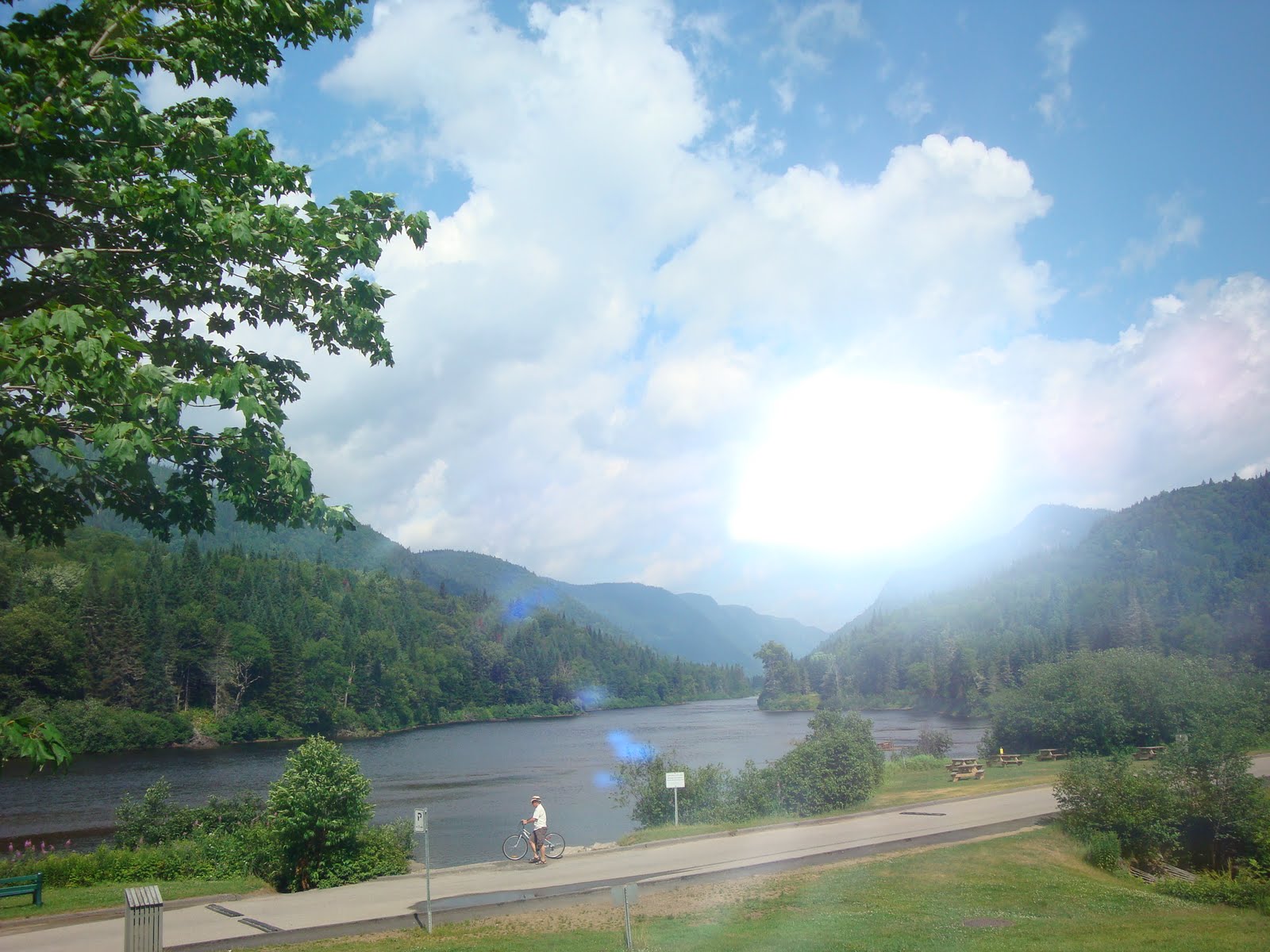
View from a mountain top at Parc de la Jjacques-Cartier.


Parc de la Jacques-Cartier: view from the lower level


See picture.


Quebec Parliament Building. We passed through this massive provincial government building as part of our Old Quebec tour, but I'll have more to say about it after a planned inside tour next week.

A giant statue of Samuel de Champlain, the founder of Quebec City.


Downtown Quebec City at night. On any of the days that I have been there, the downtown area has always been very busy with people leisurely strolling -- perhaps because of the summer festivities that are underway, or perhaps because that is the way it is. I'm convinced it is more of the latter, as most of the people you see there during non-event periods have a tourist appearance.


One of the amazing performers at Cirque du Soleil in lower Quebec City. The event is summer long, and we had to line up 3 blocks to attend the opening day-- it is free, even though, perhaps to remind us all that it is not to be taken for granted, it also had a "VIP" section, where you needed to have a special pass to get through.

Another performance at the Cirque du Soleil.


Front view of Pavillon Louis-Jacques Casault.
A friend thought this building looked like a church; another friend, on a different day, said it looked like a prison; yet another friend thought it of it a church-prison -- whatever that means. I don't know what to think of the building because I have not been inside yet.


The view from my dorm room.